

The Pioneer House
This modest house is believed to be as old as the town. There are several indications that it was built in the 1830’s. “Noggin”- a wall of bricks between the inside and outside walls – helped to keep the house insulated and protected from varmints. The structural wood shows hand saw marks; after 1842, a circular saw was used. The house has a shelf chimney which starts three-fourths of the way up the wall and goes to the roof. This simple house has two rooms up and two rooms down with a shed on the back which became part of the house.
In 1839 Irondequoit separated from Brighton and became a new town. The wilderness slowly turned into farms. For more than a hundred years, the house was a home to many families. The first family to live in this house is believed to be a farmer, his wife, seven children and a hired hand. The house had several owners and was frequently a rental dwelling.
This simple little house has been in Irondequoit through the phases of wilderness, farm land and residential town. It was a family dwelling in its first two locations – Ridge Road East & Culver, and 1581 Ridge Road East. In its third location on Portland Avenue, it was a gift shop known as the Strawberry Saltbox. Now it is located on the Town Hall property. The house was moved three times by three generations of Matthews Building Movers.
Mrs. Villard donated the building to the town with the stipulation that it be used as a museum maintained by the Historical Society. On April 11, 1995, the house was moved to the west lawn and three months later, on July 4th, it was dedicated.
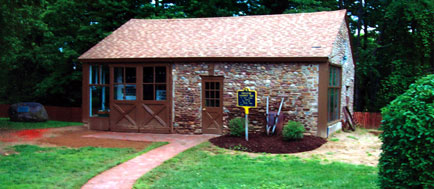
The Cobblestone Blacksmith Shop
The Cobblestone Blacksmith Shop originally located on East Ridge Road near Culver Road, was moved to the Town Hall Campus on July 14, 2008 by the Matthews Building Movers – Peter, Daniel and Andrew Matthews, and family members. It is situated just west of the Pioneer House Museum. Both the Pioneer House and Cobblestone Blacksmith Shop were erected on lot 34, township number 14, range 7 of the Phelps and Gorham Purchase, and sat side by side. They have now come full circle and are again side by side – a bit of history preserved in the Town of Irondequoit.
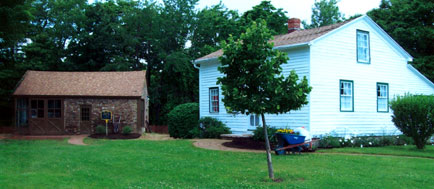
The Museum
The color of the house was changed from red to white with green trim as most houses were painted in the mid 1800’s. The foundation has a facing and steps from Upper Falls.
The east room has a permanent display of a mid 1800’s kitchen. The walls are finished in the original way with lath, plaster and a little horse hair. (You can see this in a cut-away in the kitchen). The thin floor was replaced to match the original floor in the west room.
The west room is a display room with changing exhibits about Irondequoit. The walls have been plastered and the floor is original. An 1865 piano is used for special events. Some of the glass window panes are original with bubbles and lines. The walls in the stairwell show the original lumber. The two rooms upstairs are for storage and future displays.
The shed, which gradually became part of the house, is a bookstore for Irondequoit Historical Society publications and a gift shop for appropriate items.
The kitchen garden in the side yard has plants our ancestors knew. Some trees and bushes planted near the house are dedications or memorials.
The Pioneer House is made possible by the efforts of many people and organizations who believe that the history of the town is for everyone to see and know. It is a reminder of the lifestyle of those who built this town and left us all a proud heritage.
For the latest information on Society happenings, visit our Facebook page.
 IrondequoitHistoricalSociety